Harsha Bhogle Turns a Post-Match Moment Into Genuine Human Storytelling
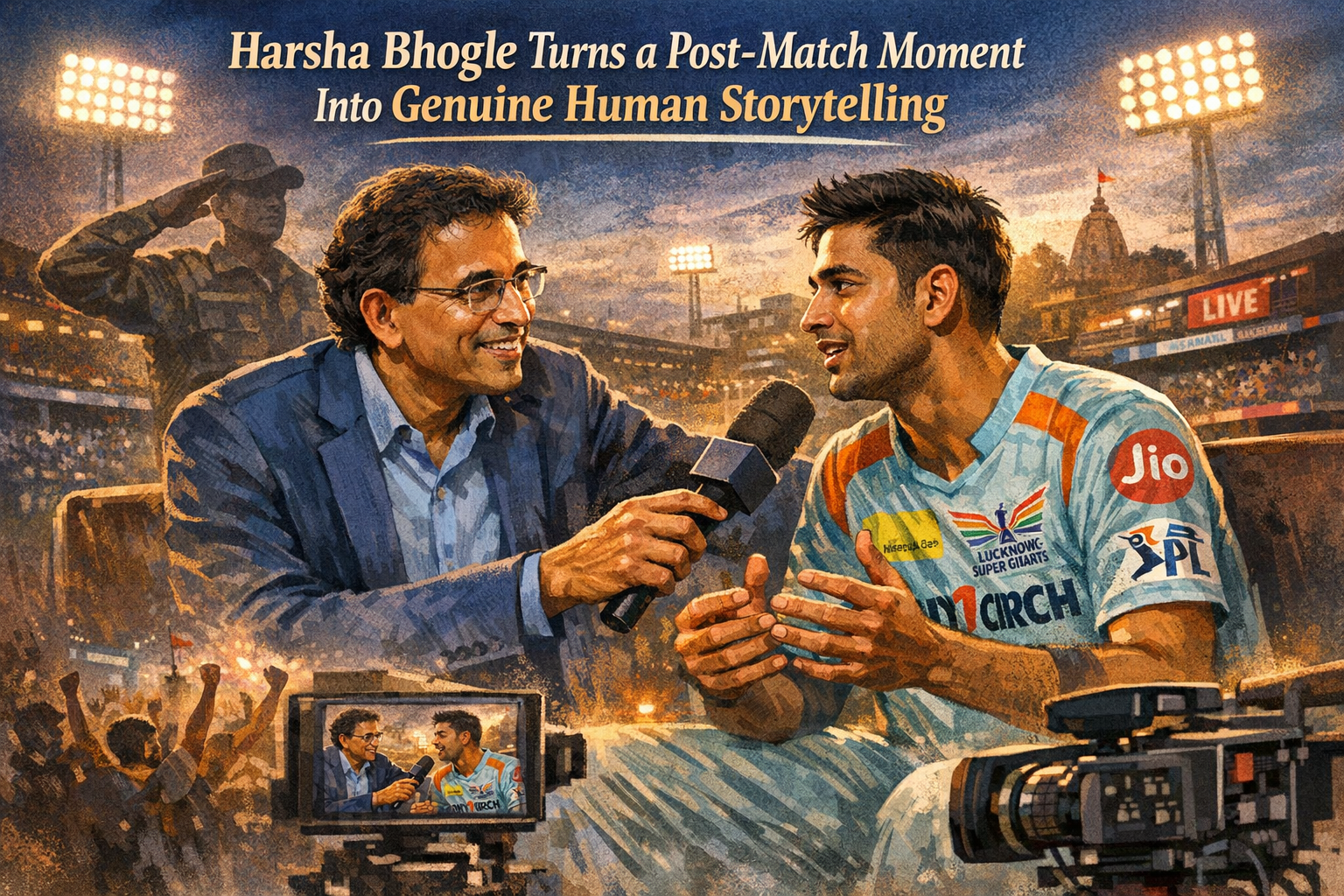
Some of the most memorable moments in broadcast journalism do not occur on the main stage — they unfold in the quiet minutes immediately after, when the adrenaline is still present but the guards have come down. That is precisely what happened when veteran commentator Harsha Bhogle sat down with Lucknow Super Giants' Mukul Choudhary following a high-stakes encounter against Kolkata Knight Riders. What emerged was less a formal interview and more an unscripted portrait of a young man navigating extraordinary pressure — and it reminded audiences why skilled broadcast journalism remains irreplaceable.
When Broadcasting Becomes More Than a Formality
Post-event interviews in professional broadcasting are often formulaic. A microphone is extended, a few predictable questions are asked, and clichés are exchanged. The format rarely demands depth. What Harsha Bhogle consistently does differently is preparation rooted in genuine curiosity. He arrived knowing Mukul Choudhary's background — the city he came from, the culture that shaped him, the kind of community that raised him. That knowledge was not decorative. It became the architecture of the conversation.
Bhogle drew a connection between Mukul's hometown and its tradition of producing individuals who join the Indian armed forces — a detail that transformed the interview from a performance review into something far more human. He noted that Mukul had performed like a soldier under pressure, a characterisation that landed with precision because it was grounded in a specific, verifiable cultural reality, not a generic compliment. This is the difference between a broadcaster who reads briefing notes and one who understands context deeply enough to use it live, without a script.
The Psychology of Pressure and How It Gets Articulated
Mukul's own response was notable. Asked how he managed to hold steady when experienced figures around him had not delivered, he offered a candid observation: pressure, he said, can either build a person or destroy one. It is a simple statement, but in the context of a live broadcast, with millions watching, its honesty carries weight. Young professionals in high-visibility roles — whether in broadcasting, medicine, law, or performance — rarely speak so directly about their internal states. The willingness to do so usually reflects a combination of genuine self-awareness and an interviewer skilled enough to create the conditions for it.
Bhogle's approach to that moment exemplifies what communication researchers have long identified as active listening in a professional context: the ability to create psychological safety within a structured public exchange. He did not interrupt, redirect, or diminish. He allowed the response to breathe, and in doing so, made it memorable.
Why Human Broadcasting Cannot Be Replicated by Formula
The IPL season has produced no shortage of dramatic finishes and individual brilliance. But drama alone does not create meaning — it requires narration, framing, and emotional translation. This is precisely what experienced broadcast journalists provide. Harsha Bhogle, across a career spanning decades, has built a reputation not on volume or excitability, but on the quality of the questions he asks and the depth of the knowledge that informs them.
Knowing where a person comes from, understanding the cultural weight of that background, and finding the precise language to reflect it back — that is not a skill that arrives quickly. It accumulates through years of research, attentiveness, and a genuine interest in the individuals behind the professional role. The conversation with Mukul Choudhary was, by most accounts, one of the finest post-event broadcast exchanges of this IPL season — not because anything extraordinary was said, but because everything said was exactly right.
The Broader Value of Depth in Live Broadcasting
There is a wider cultural conversation to be had here about the direction of broadcast journalism. As media consumption fragments and attention windows shorten, the pressure on broadcasters to be faster, louder, and more reactive intensifies. Long-form understanding — the kind that allows an interviewer to connect a young cricketer's composure to the martial tradition of his hometown — requires time, investment, and genuine intellectual engagement. These are qualities that short-form content cultures tend to undervalue.
What Bhogle demonstrated with Mukul Choudhary is a quiet argument for the opposite: that audiences still respond to depth, that authenticity still cuts through, and that the most enduring broadcast moments are rarely the loudest ones. They are the ones where a single, well-chosen observation makes a viewer feel that they understood something they had not understood before. That is the standard worth preserving — and in this particular exchange, it was met with considerable distinction.